
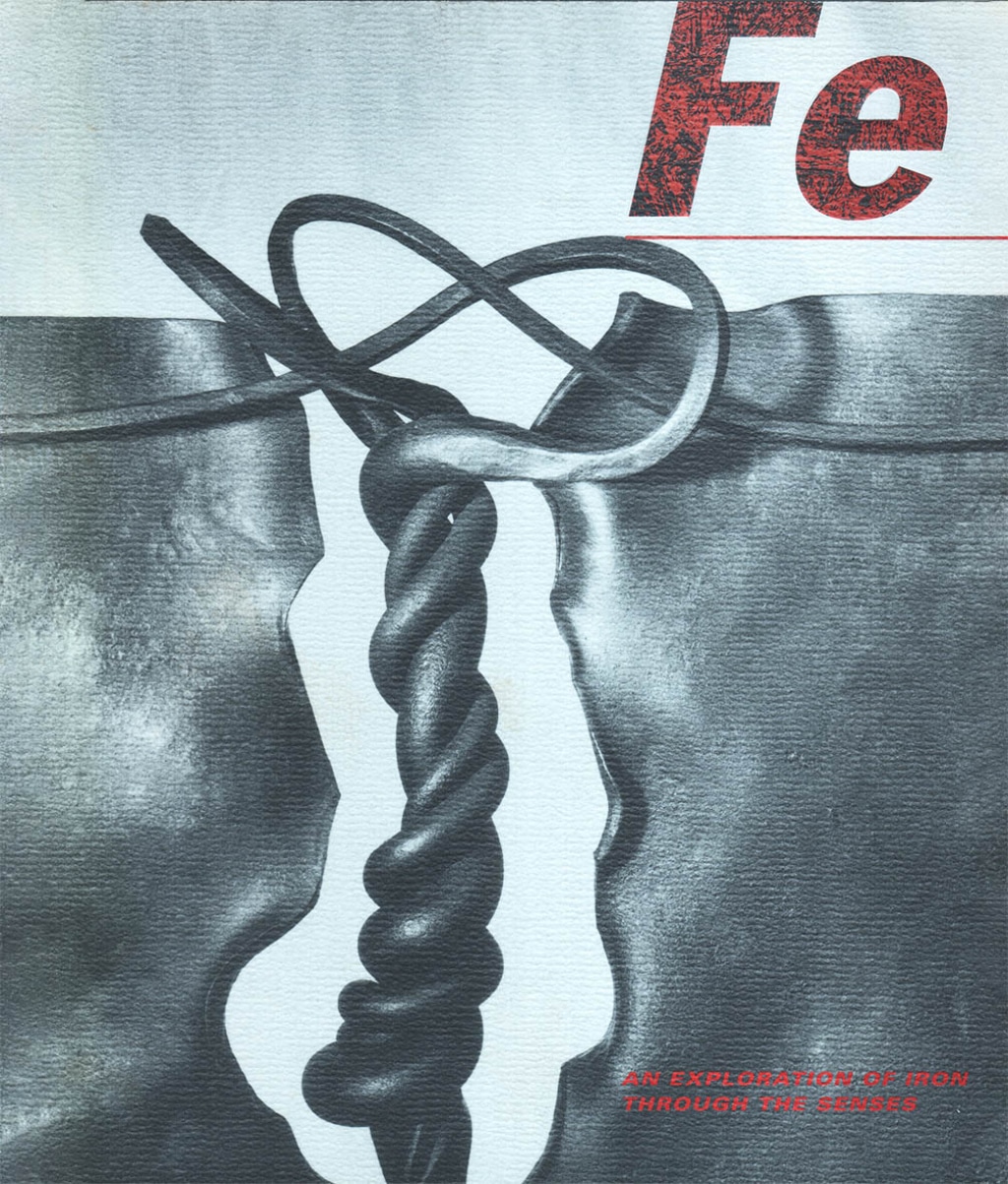
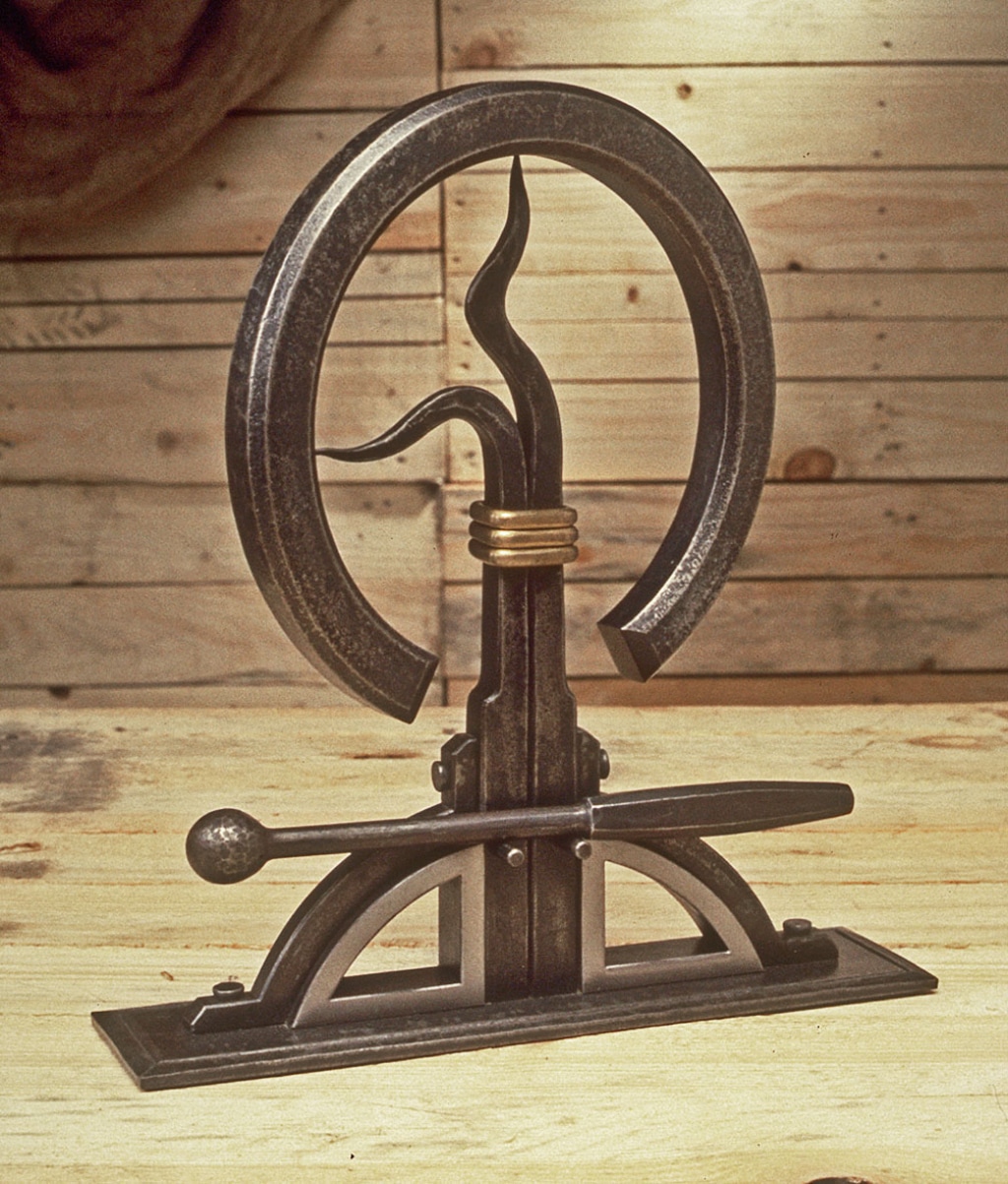
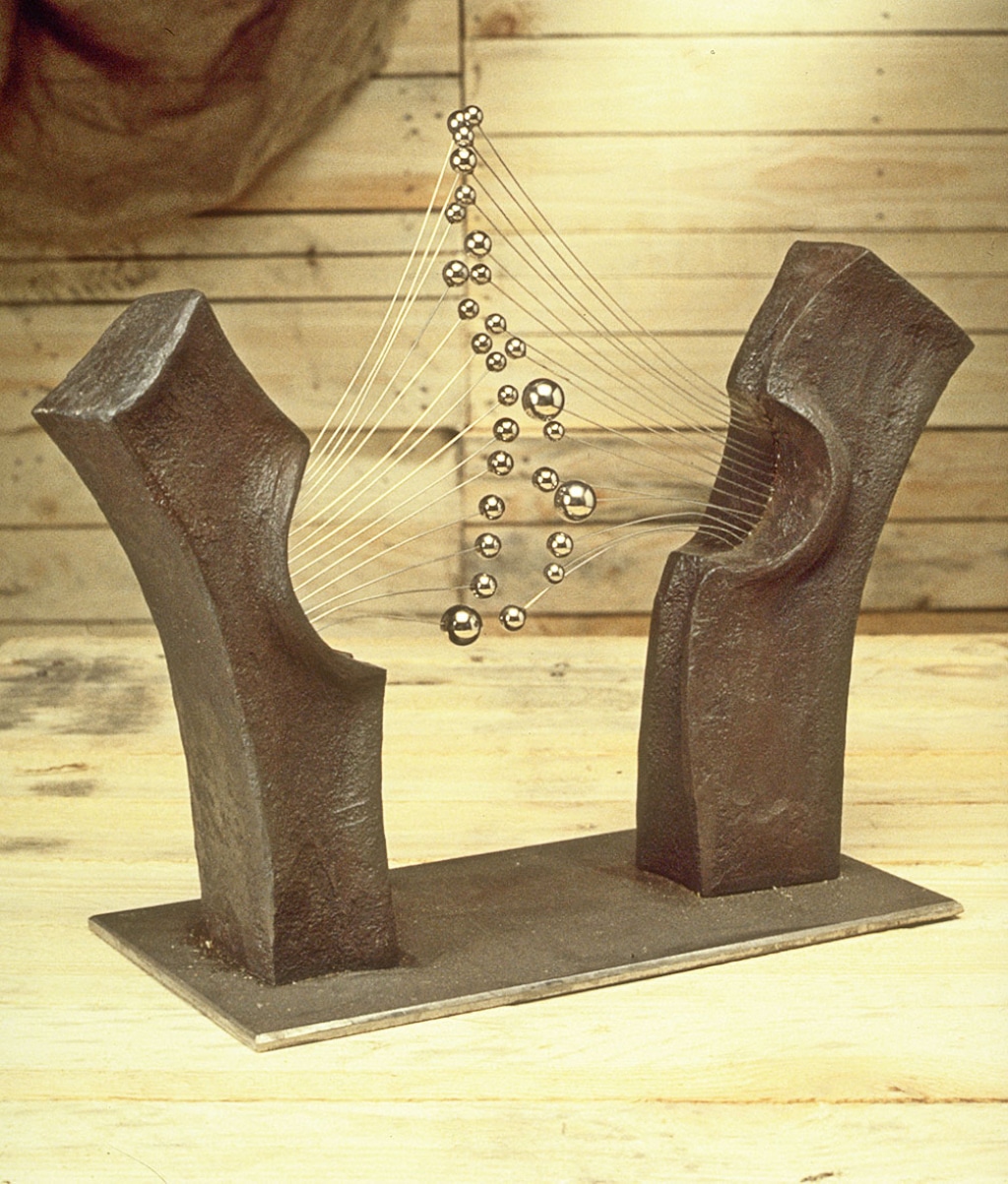
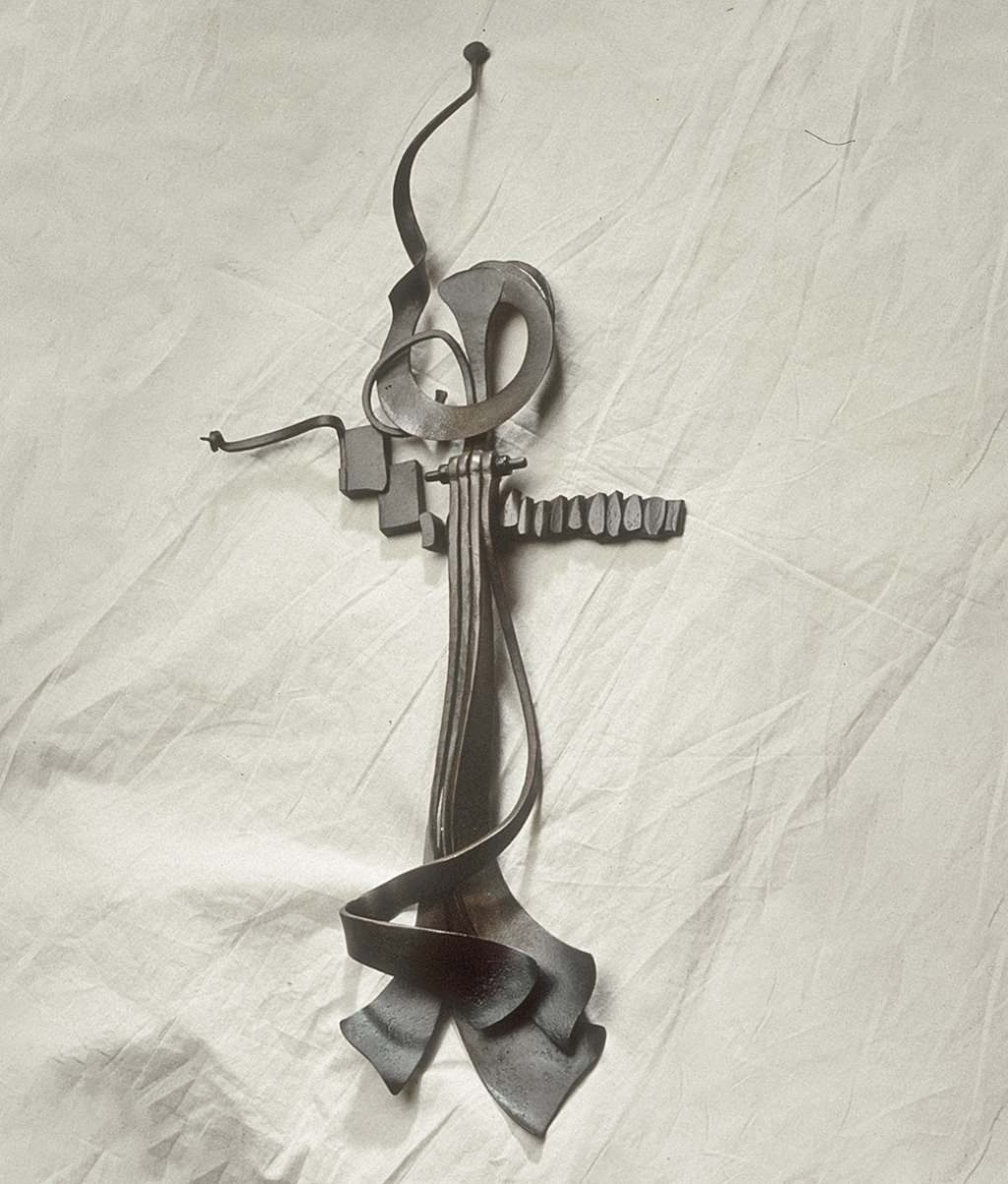
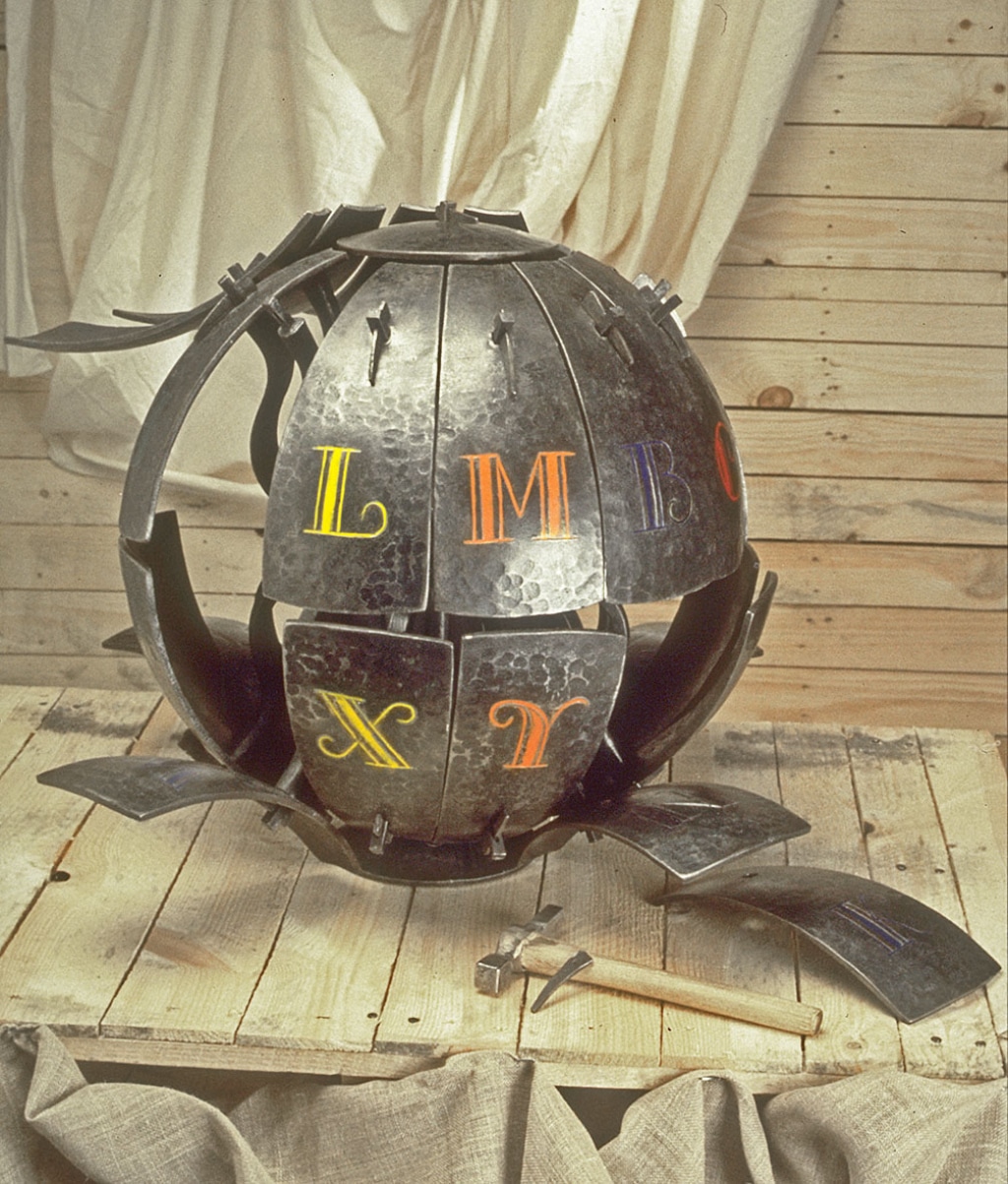
Fe - An exploration of Iron through the senses

The Brief
The exhibition brief was an invitation extended to all blacksmiths worldwide to:
Create a work which encapsulates those senses which are in addition to the visual. The purpose was to utilise qualities which are inherent in steel and iron, but rarely explored. Tactile and aural qualities appeal particularly to those who are visually impaired: but they are also aspects encountered intuitively by the viewer. The design should seek to expand visual appreciation of objects by offering at least one other sensory experience in the observer’s interaction with the object
The piece should not be made for the physically impaired per se. Visual impact must be fully integrated with tactile qualities and/or elements to create a coherent whole. Visitors to the exhibition will be encouraged to respond to the work by touching or operating.
The choice of the object was left to the maker. It was envisaged, however, that the items in the exhibition would consist of mainly functional objects, small and large, which may be handled and operated. The design must fulfil its purpose efficiently and give satisfaction and enjoyment.
The Exhibition
An exhibition team was put together who then began the task of developing the concept of a national touring exhibition of contemporary metalwork into a saleable commodity.
The idea behind the senses as the theme was to encourage participating artist blacksmiths to develop their creative ideas beyond the usual visual perception and appreciation of their work and to include along with the visual, one other sensory experience.
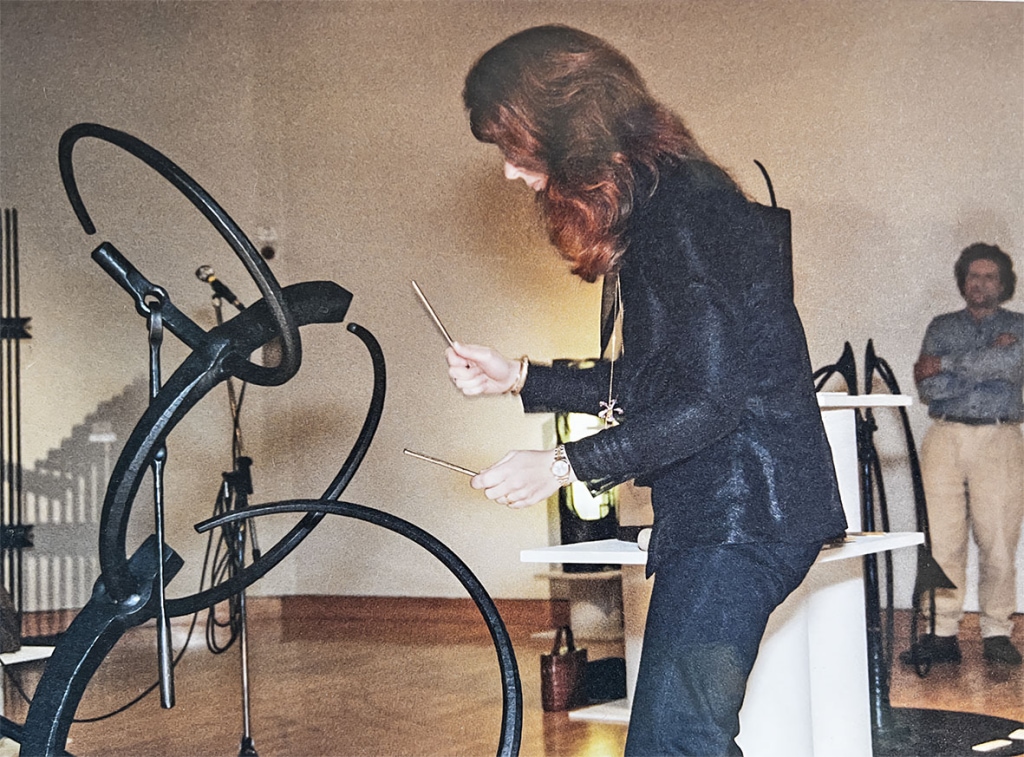
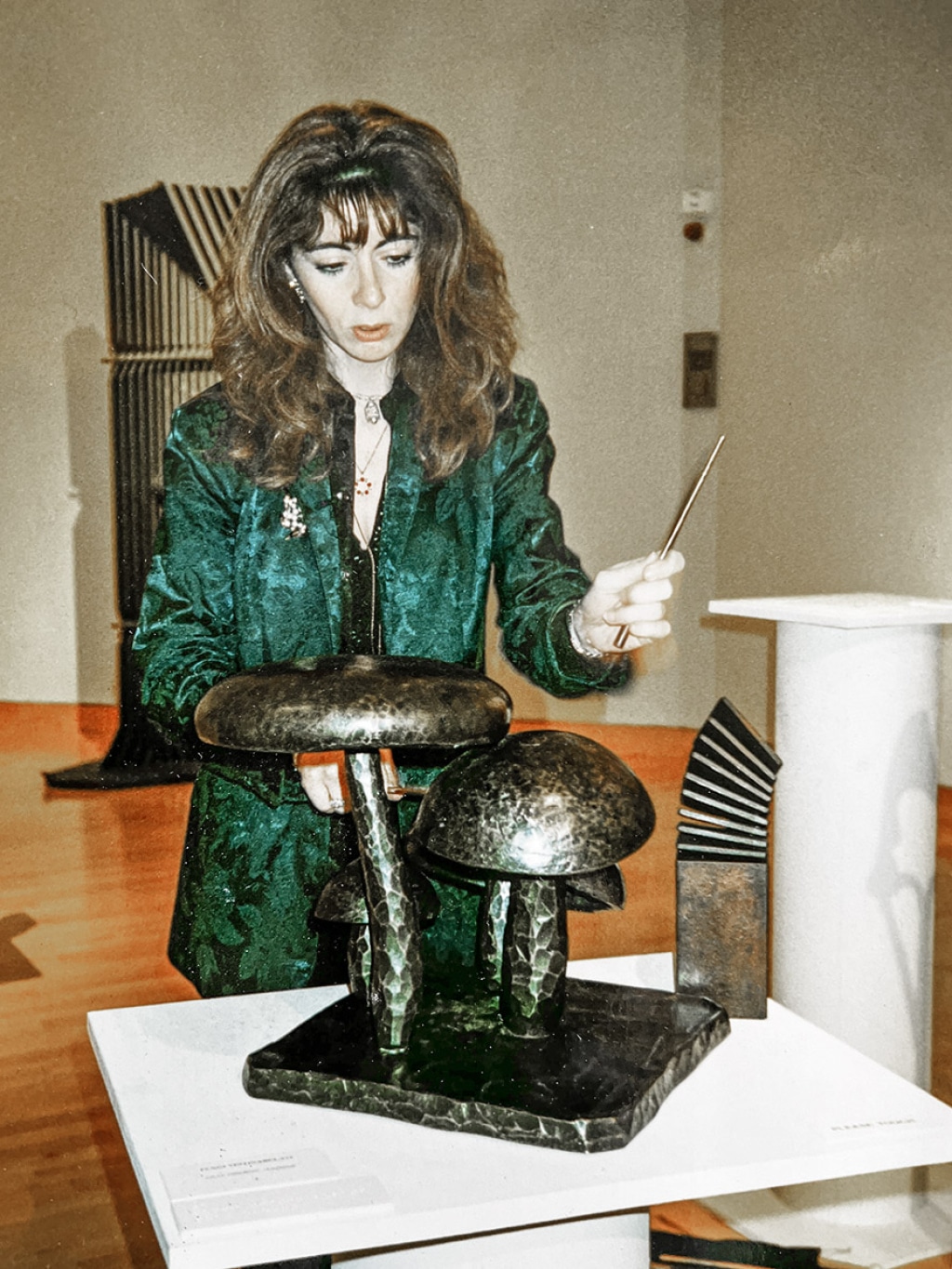
The public viewing the exhibition would be encouraged to participate with the exhibition pieces, where appropriate, and to enjoy a multi-sensory experience and an appreciation of the work, arising from the opportunity to touch, handle or operate.
With 1996 being the Year of Visual Arts in the Northern Region, the touring exhibition's final venue was at Tullie House, Carlisle, in September 1996, with an international blacksmithing conference and forge-in to coincide with this final exhibition venue. Northern Arts were very keen on the concept and also on the
development of the making of a large piece of public work to donate to the major sponsor of the exhibition. The gift would be made in stages throughout the two-year exhibition tour at forge-ins coinciding with the touring exhibition venues. The final extravaganza would be the bringing together of all the pieces made and finishing the piece of work off at the Blacksmiths International Needle Conference (BLINC) and forge-in.
Public funded art galleries up and down the country were contacted with information about the exhibition and invited to book the tour. Sponsorship and funding applications were made to cover the two-year tour of the exhibition.
There was a total of 130 pieces of work submitted for the selection process at Ironbridge. Work from British blacksmiths was delivered to Ironbridge and the overseas work was selected from slides. The selection panel of five spent a full day together working hard, assessing the work and finally selecting a total of 60 pieces of work which they personally felt complied with the exhibition brief and which worked together as a coherent whole. The work selected showed a well-balanced representation of innovative work which we were sure would delight and entertain the majority of the public who would go along to the art galleries where the work would be on show.
Once the touring exhibition was on the road, we were required to install and dismantle the exhibition at each venue and handle the transportation between venues of the exhibition works, the plinths and supporting visual materials. At certain venues throughout the tour, we held a forge-in where component parts were made to tie up with the final forge-in at Tullie House.
The exhibition went on to tour the UK for two years from January 1995 to November 1996. It was shown at the following venues:
Milton Keynes Exhibition Gallery, Milton Keynes
Northern Centre for Contemporary Art, Sunderland
Kelvingrove Art Gallery and Museum, Glasgow
Harley Gallery, Nottingham
The Shire Gallery, Stafford
Bradford Design Exchange Centre, Bradford
Oriel Gallery, Theatre Clwyd, Mold, Clwyd
Fire and Iron Gallery, Leatherhead
Mead Gallery, Coventry
The Smith Gallery, Stirling
Tulie House, Carlisle
Selecting for the Fe Exhibition
Peter Parkinson
Judging took place at Ironbridge, for the first selected exhibition that BABA had organised. Since it was a new departure, I was asked to explain something of the process which was used to arrive at that selection.
The Selection Panel Comprised Steve Chettle, Public Arts Officer for Cumbria; Emma Dent-Coad, Art Critic and Writer; William Kirby, Arts Consultant to the Royal National Institute for the Blind; Paul Zimmerman, Artist Blacksmith, Demonstrator and Lecturer from Germany; and myself, Artist Blacksmith and Lecturer from Hampshire.
The selection process was greatly assisted by the very thorough preparation undertaken by Shona Johnson and her team, so we were presented with work identified by a number only, corresponding to a
catalogue entry and a numbered artist's statement. Some thirty entries were presented on slide, while around ninety pieces were actually there for us to see and examine.
After some initial discussion, it was decided that we would review the work as individuals, make our own
assessment and mark each piece "Yes”, No", or “Possible", coming together afterwards to reconcile our
marks. This system had the advantage of eliminating what might have been lengthy discussions, had we tried to agree a mark for each piece as we went along.
The final stage of the process was to tabulate all five votes recorded against each piece. These ranged from five "Yes" votes to five "No" votes, but more typically would perhaps be three "yes" votes one "possible" and one "No". In arriving at a conclusion, the "Possible" vote was seen as a positive assessment, so it was not difficult to arrive at a final score for each piece which reflected the
consensus of opinion within the Panel. The selected pieces were therefore those which on balance received a positive vote.
This proved to be an effective system - accurately reflecting the feeling of the Panel as a whole, although it did mean that some pieces were approved which had been given a "No" vote by at least one judge. So, although as an individual any one of us would not perhaps wish to defend every piece chosen, the selection was nevertheless, the democratic view of the Panel, which itself had been appointed to represent a breadth of informed opinion.
Speaking personally, it was a very interesting, stimulating, intriguing and demanding day. My overall impression was of a high standard of design and making. Clearly a lot of people had seen this opportunity as a real challenge and worked hard to give it their best.